

play infinite games
why giving first (and cleaning the bathroom) is the most rational move you can make.


We have all learned that ‘giving first’, doing good for others and paying it forward is the morally right way to go. Implicitly, we know that this is true. But morality alone is a weak motivator on a tired Saturday morning. So why is giving first actually a rational strategy?
saturday blues & cleaning the apartment
It’s a Saturday 10am. You really had a shitty week with long working hours, not enough sleep and barely any solo time.
You’re looking forward to just spending some time on the couch with your favorite quick-hit dopamine source.
Suddenly you remember that you made a deal with your roommate that you’d split the household chores this week – you’d clean the bathroom and she’d clean living room and kitchen.
The situation you’re facing now is what we learned in our first semesters at uni as a Prisoner’s Dilemma, one of game theory’s classic explanations for why two rational individuals fail to cooperate even when it would benefit both.
In our example, this looks like that:
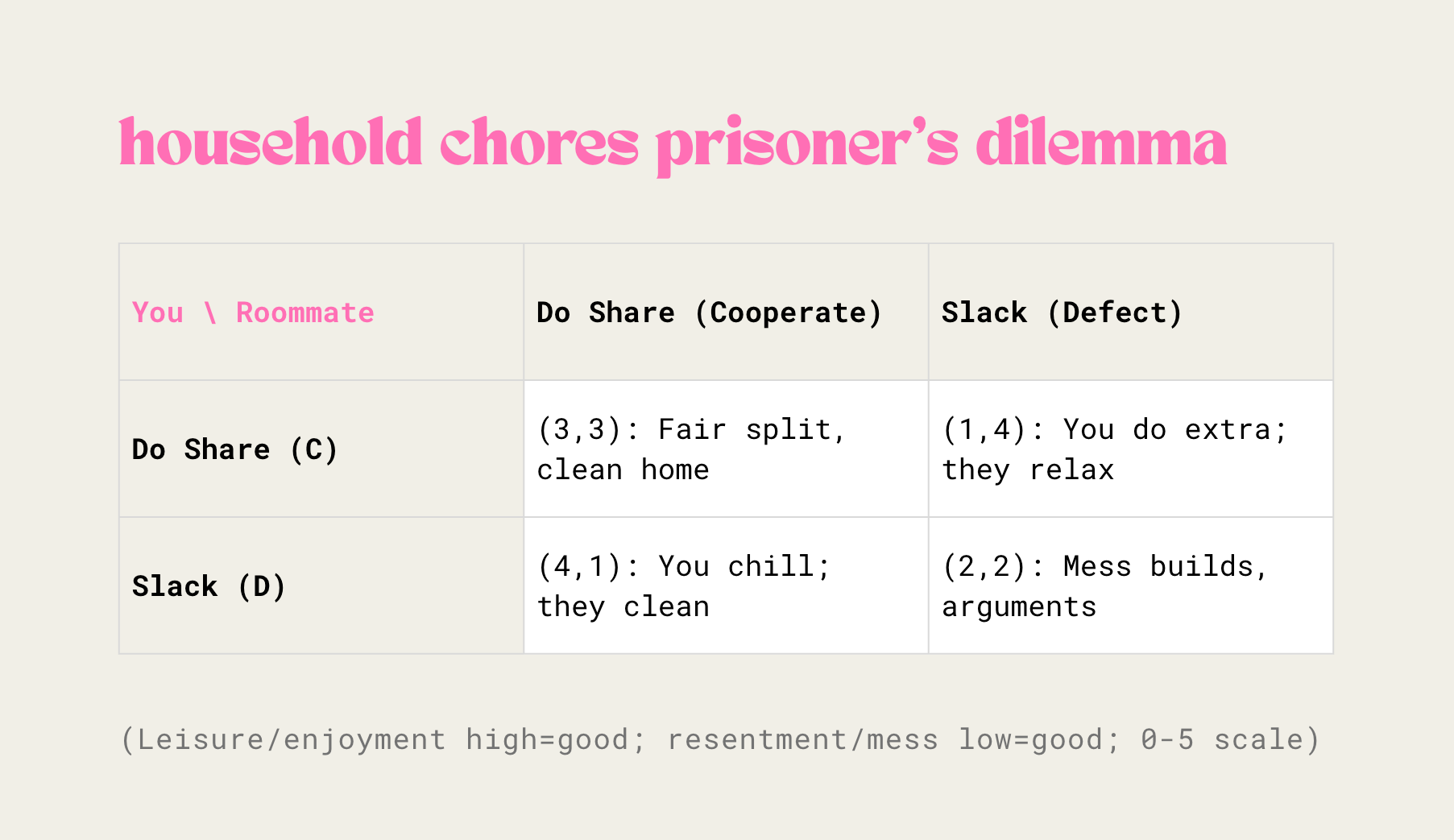
In a single-shot version, the rational move is to slack. No matter what your roommate does, you’re better off resting. And since they face the same logic, both of you defect. You end up with a dirty apartment and mutual resentment.
In other words, if there is no future, pure self-interest wins short-term leisure over collective good.
This changes in an infinite (or indefinite) version. If you two are living together for the long run (no known end), cooperation suddenly becomes sustainable with a tit-for-tat strategy. In the first week, you clean your part diligently, signalling positive intent. You warn your roommate, that you will do as they do – they don’t clean, neither will you in the week after. This reciprocity yields a new Nash equilibrium of both of you properly doing their chores. Because if you don’t, this will unravel a mess at home.
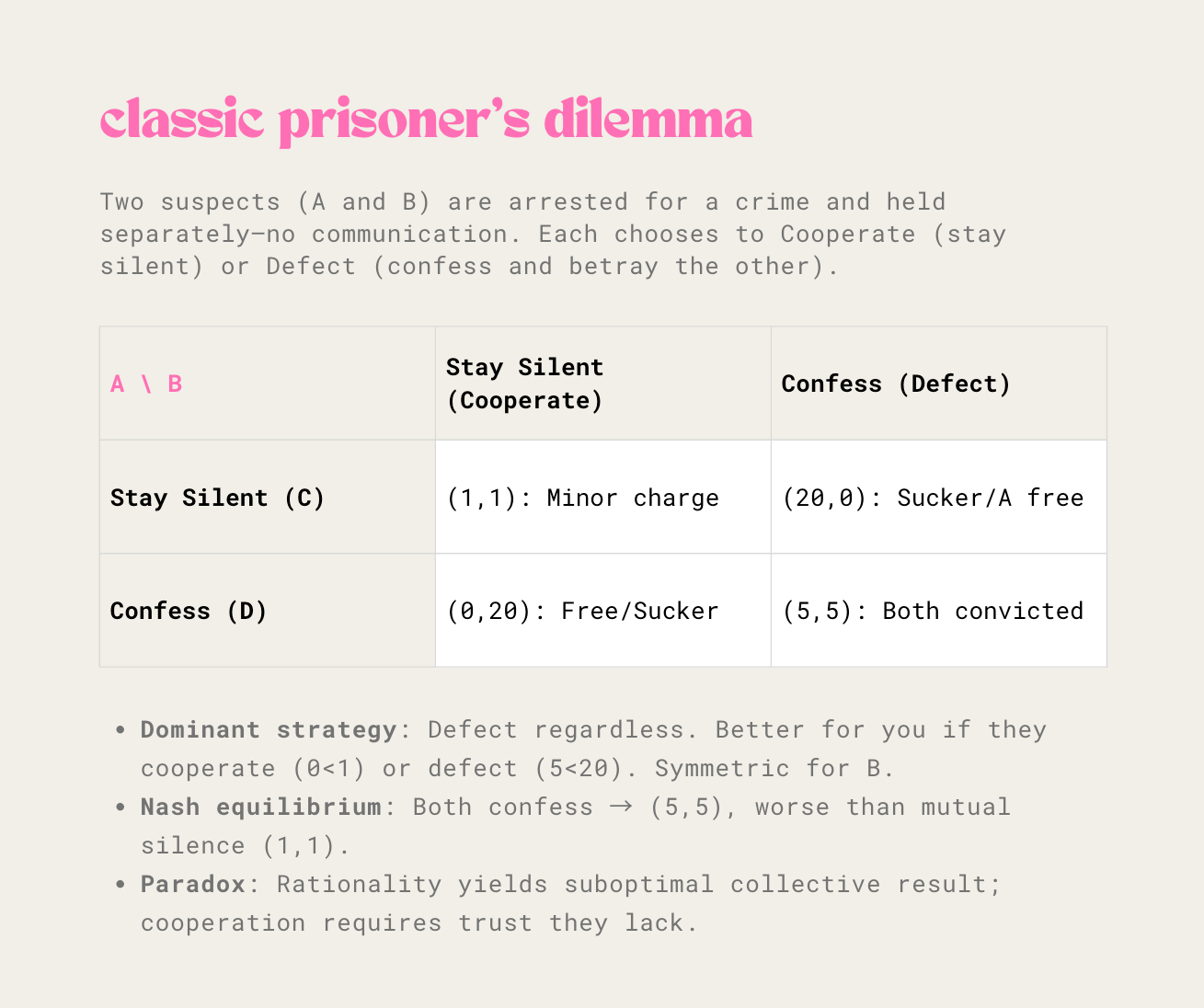
We know single-shot prisoner’s dilemmas from many day-to-day situations.
You’re a tourist buying from a street vendor in a foreign city you’ll never revisit, you’re overpaying big time.
You’re riding a cab in a new city and the driver picks the longer route.
A stranger on a car highway ahead won’t let you in during rush hour.
It’s tempting to label these people as *ssholes. But maybe they’re just responding to the incentives in front of them.
In situations that (a) have anonymity and (b) no continuation, the little devil on our right shoulder will urge us to maximize your own profit at the cost of greater good.
This feels wrong. This is not how our parents raised us.
The reason this still happens is due to two faults.
people misunderstand the game they are playing, or…
they are lacking ethical scaffolding to resist short-term temptation
play the right game
Life is an infinite game.
The world is smaller than we think and reputations travel faster than ever. Doing a bad job in your last internship week or pulling back from a signed job offer last-minute might serve you well in the short-time. Chances are, it will come back at you. Through a bad reference or by the counterpart suddenly crossing paths 10 years later again.
And even if you don’t, the reality of a 1:1 prisoner’s dilemma is actually one of countless intertwined versions. You fool one person, and this one person will take that doubt into all of their following interactions. Distrust spreads. And sooner or later, you live in the system you helped create.
This creates a ripple effect: Even if the other person never meets you again, your behavior leaks into the system. Every small defection lowers the baseline of trust, and every small cooperation raises it.
Assuming infinite instead of single-shot games as a default will do you good in the long run. Cooperation > defection.
play the game rightly
Still, there will always be douchebags playing the game for their own good only. That’s why laws exist. They transform single-shot temptations into repeated games with consequences.
This need for an ethical scaffolding is something the Greeks knew already long before Zaziki and Bifteki took the world by storm: Virtue ethics such as Aristotle’s underline that cultivating virtuous habits like courage, justice, and wisdom will lead toward eudaimonia, a flourishing life.
This sets “cooperation” as an ethical baseline, which consequently benefits all people together.
Your shitty-week couch urge? Aristotle tells you to clean anyways to cultivate a reliable self and consequently play the infinite game rightly.
Every small act of cooperation is a vote for the kind of person you are becoming.
giving first is a valid strategy in life
This little excourse into game theory and Nicomachean ethics was to prove one point only.
‘Giving first’ is a valid strategy in life.
Rationally, it is the positive signal showing others that you are worth cooperating with in the infinite game of life.
Ethically, giving first will pay into being a virtuous person one act at a time.
The game we are all playing is long-term. And every time you choose to give first, you’re deciding what kind of player you are.